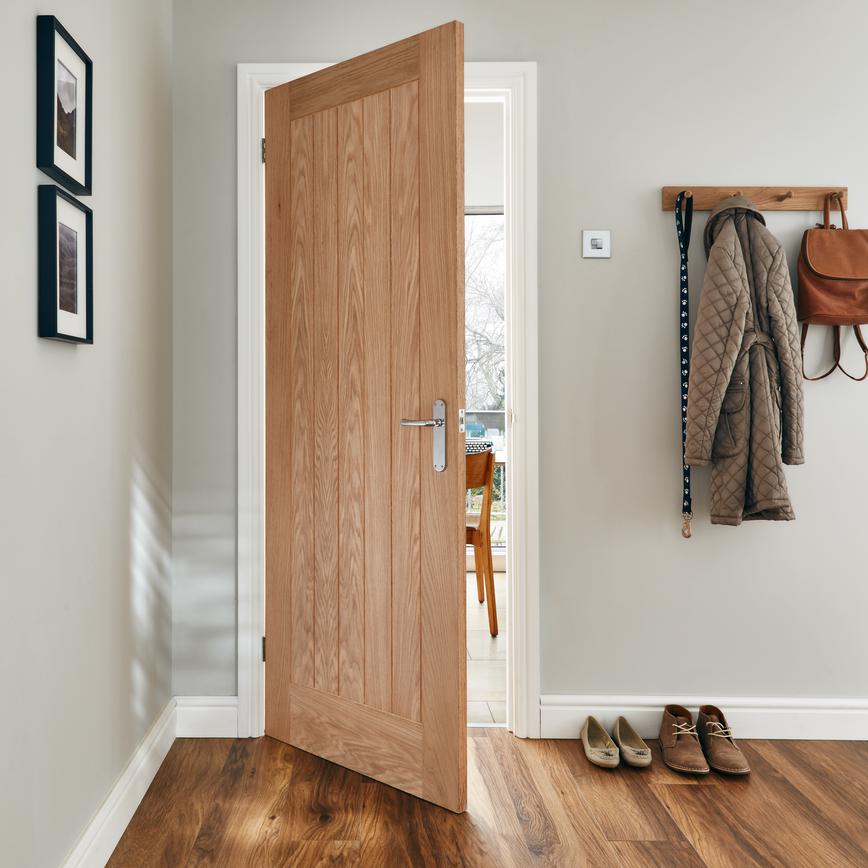
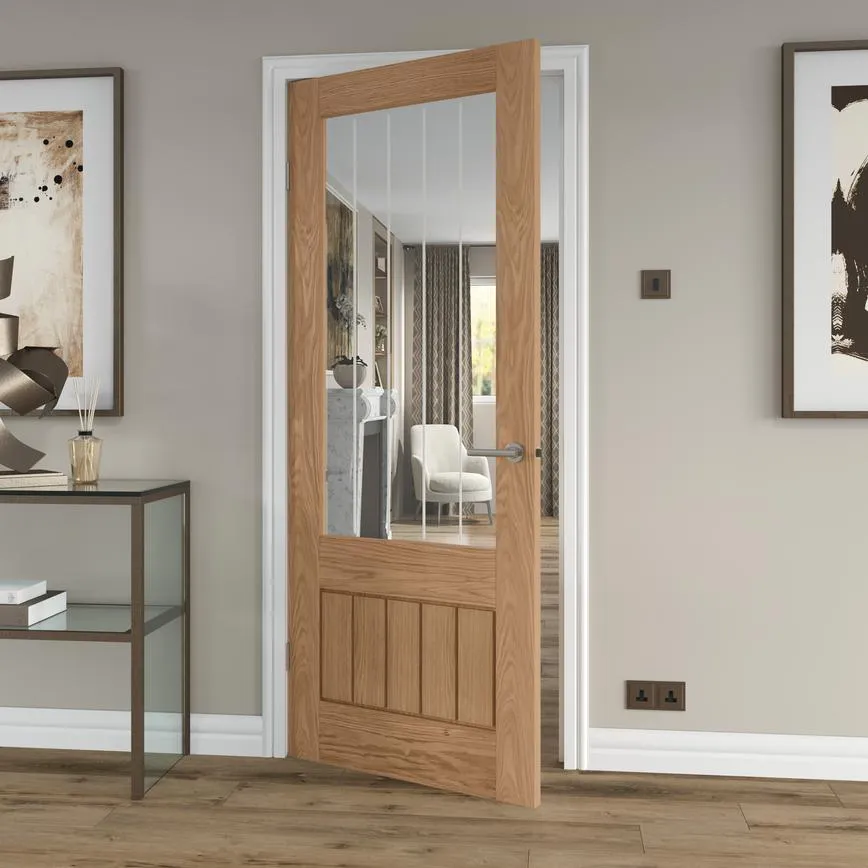
Oak vs white internal doors is a common starting point, but glazed doors add a third useful option when a home needs more light. The best choice depends on the rooms, décor, maintenance preferences, privacy and the budget for the complete supplied-and-fitted project.
This practical guide compares oak, white moulded and glazed internal doors for homes around Leicester and the Midlands, then explains how to combine styles without making the property feel inconsistent.
Choose by room function first, then appearance
Oak adds warmth and natural character. White moulded doors offer a clean, versatile and cost-conscious finish. Glazed doors move borrowed light between rooms. Many homes benefit from a coordinated mix rather than one door type everywhere.
- Oak for natural warmth
- White moulded for flexible style
- Glazed for shared light
- Professional supply and fitting
Oak, white moulded and glazed doors compared
| Factor | Oak doors | White moulded doors | Glazed doors |
|---|---|---|---|
| Look | Natural grain and warm timber tones | Clean painted finish in traditional or modern panel styles | Open, light-enhancing appearance in oak or painted designs |
| Best suited to | Feature-led, traditional, cottage and warm modern interiors | Whole-home updates, neutral schemes and controlled budgets | Hallways, kitchens, dining rooms and darker connecting spaces |
| Privacy | High with an unglazed leaf | High with an unglazed leaf | Depends on clear, obscure or patterned glass |
| Finishing | Unfinished versions need suitable protection; pre-finished versions arrive coated | Primed versions normally require the specified topcoats; fully finished options need less decorating | Depends on the surrounding door material and factory finish |
| Budget | Often above standard moulded options | Frequently the most cost-conscious route | Usually above the equivalent unglazed design |
| Installation | Weight and veneer trimming limits matter | Construction and permitted trimming still need checking | Weight, glass safety, privacy and handling need consideration |
Oak internal doors
Oak-veneered doors bring visible grain and warmth into a room. Cottage, shaker and contemporary grooved designs can work in both traditional and modern properties.
Advantages
- Distinctive natural appearance
- Wide range of panel and glazed designs
- Works well with timber floors and furniture
- Available unfinished or pre-finished
Considerations
- Natural grain and tone vary between doors
- Unfinished doors need the correct protective finish
- Heavier designs need suitable hinges and sound frames
- Usually a higher product cost than basic moulded doors
White moulded doors
White moulded doors are practical for creating a consistent look across several rooms. Panel, cottage and contemporary styles can blend with many colour schemes.
Advantages
- Clean and adaptable appearance
- Useful for coordinated whole-home replacement
- Often the most budget-friendly category
- Different core constructions available
Considerations
- Primed is not always the same as fully finished
- Marks can be more visible on white surfaces
- Hollow and solid-core models feel and perform differently
- Final paint preparation should follow product guidance
Glazed internal doors
Glazed doors allow light to pass between adjoining spaces while maintaining physical separation. They are available in oak, white and other finishes.
Advantages
- Helps brighten darker hallways and rooms
- Can make connected spaces feel more open
- Clear and privacy-conscious glass options
- Creates a useful feature door
Considerations
- Privacy varies by glass design
- Usually costs more than the unglazed equivalent
- Glass shows fingerprints and needs cleaning
- Weight and careful handling affect installation
Want a coordinated recommendation for your home? Send the room list, door quantity, postcode and a few photographs. Grafton Carpentry can help compare suitable styles before supplying and fitting the doors.
Which internal door works best in each room?
Hallways and landings
Consistency matters because several doors may be visible together. Oak creates a strong feature; white moulded doors keep the scheme lighter. A glazed kitchen or living-room door can share light with the hallway.
Living and dining rooms
Oak works well where the door forms part of the décor. Glazing can connect adjoining entertaining spaces visually while still allowing each room to be closed.
Kitchens
A glazed design can move daylight into a hall or dining area. Consider visibility, glass cleaning and whether the opening has any specific fire-safety requirement.
Bedrooms
Unglazed oak or white moulded doors normally provide the privacy most homeowners expect. Construction choice can matter where a more substantial feel or improved sound reduction is important.
Bathrooms
Privacy is the priority. An unglazed leaf is the usual choice, with an appropriate bathroom lock and finish that can cope with the room conditions.
Home offices
Choose an unglazed door for visual privacy or a partially glazed option where borrowed light is more important. The door construction and gaps also influence how separate the workspace feels.
Can you mix oak, white and glazed doors in one house?
Yes. A mixed scheme can look intentional when it follows a simple rule. Keep the same panel language, finish family or handle style, then use glazing only where it solves a practical light problem.
For example, a home might use matching oak cottage doors throughout, with glazed versions for the kitchen and living room. Another might use white four-panel doors in bedrooms and a matching white glazed design between the hall and dining room.
Unfinished, primed or pre-finished?
The surface condition changes how much work remains after the door arrives:
- Unfinished oak needs a compatible protective finish applied in accordance with the manufacturer’s instructions.
- Primed white has a preparation coat but normally still needs the specified final paint system.
- Pre-finished or fully finished arrives with the main factory finish applied, though adjusted edges still require treatment where instructed.
If oak is on your shortlist, read the detailed unfinished versus pre-finished oak door comparison.
Do door construction and fitting matter as much as style?
Yes. Hollow-core, solid-core, engineered timber, veneered and fire-rated doors can look similar in photographs but differ in weight, feel, permitted trimming and hardware requirements. Existing frames also vary, so the selected door must be suitable for the actual opening.
Grafton Carpentry’s interior door supply and fitting service keeps selection, measurement review, hardware and installation within one project. Handle packs are included with fitted-door jobs, and the written quotation confirms the agreed products and work.
For budgeting, see the 2026 fitting cost guide. To understand the installation, read how long internal door fitting takes.
Door supply and fitting near Leicester
Based in Hinckley, Grafton Carpentry serves homeowners in Leicester, Leicestershire and suitable towns across the surrounding Midlands, generally within approximately one hour. The company focuses on complete supply-and-fit projects rather than a full supply-only service.
View the areas we cover or include your postcode in the enquiry. Sending the approximate door quantity, preferred categories and room photographs helps the team provide more useful guidance.
Choosing internal doors FAQs
Are oak doors better than white doors?
Neither is universally better. Oak offers natural grain and warmth, while white moulded doors are versatile and often more cost-conscious. The right choice depends on the desired appearance, construction, maintenance and total project budget.
Do glazed internal doors reduce privacy?
Clear glass gives more visibility, while obscure or patterned glass provides greater screening. Consider the room use and view from both sides before choosing the glazing.
Are white moulded doors already painted?
Some are primed and need final coats; others are sold fully finished. Check the exact product specification rather than assuming every white door is ready for use.
Can oak and white doors be mixed?
Yes. Keep a consistent rule, such as matching doors on each landing or using the same panel style and hardware. A fitter-led plan can help the mix look deliberate.
Which doors are best for a dark hallway?
Glazed doors to adjoining living spaces or kitchens can share natural light. White finishes also reflect more light visually, although the best combination depends on privacy and the layout.
Get help choosing, supplying and fitting your internal doors
Tell Grafton Carpentry which rooms you are updating, how many doors you need and the look you prefer. The team can compare suitable oak, white moulded and glazed options and provide a tailored supply-and-fit quotation.